
Driving responsible AI adoption

Responsible AI implementation starts with deep research to understand where AI can deliver real value. Rigorous testing, user research, and small but scalable pilots ensure that AI-powered solutions are human-centered, trustworthy, and usable.

  • Establishing scalable, trustworthy AI delivery for Veteran health care

    The U.S. Department of Veterans Affairs (VA) recognizes the potential of artificial intelligence (AI) to transform care delivery and reduce administrative burden. However, moving these ideas from research into trusted, tested solutions is challenging and requires rigorous testing and evidence of value, security, and scalability. VA’s National Artificial Intelligence Institute (NAII) tapped Aquia Nava II LLC, our joint venture with Aquia Inc., to help develop a human-centered model for implementing AI tools. Our shared work helped enable the agency to explore AI-powered solutions that improve VA staff and Veteran experiences.

    NAII adopted a delivery-first, human-centered model to establish the multidisciplinary structure and rigor needed to mature AI-powered use cases from concept through pilot. We worked with NAII to conduct ethnographic research and clinician interviews to map actual workflows, ensuring AI-powered solutions aligned with operational needs. For every use case, we helped NAII develop baseline metrics, hypotheses, and criteria to measure return-on-investment before committing to full pilots.

    This engagement enabled NAII to establish a repeatable, scalable model for AI-powered delivery and intake. We helped transform high-priority use cases from abstract ideas into structured project discovery with workflows, testing, and evaluation, reducing the risk of deploying AI-powered solutions that clinicians wouldn’t adopt or that would fail to deliver measurable value. The rigor and structure proved that VA can responsibly advance AI adoption at scale while maintaining the trustworthiness Veterans and clinicians require. With a proven delivery model in place, NAII can confidently pursue AI-powered initiatives that serve Veterans faster and more reliably.

    To learn more, read the full case study.
  • Accelerating disability benefits for Veterans with AI-powered claim classification

    When Veterans apply for disability benefits through VA.gov, they have to describe their medical conditions in their own words. Then, a U.S. Department of Veterans Affairs’ (VA) system classifies each condition, determining the claim’s next steps. Previously, VA couldn’t classify about 25% of conditions because the system required Veterans’ descriptions to exactly match predetermined entries. Our joint venture with Aquia Inc. helped VA develop an automated classification system that handles varying Veteran descriptions and evolving medical terminology.

    VA’s new, hybrid classification system combines the precision of rule-based lookup tables with the flexibility of machine learning. Now, when a Veteran submits a claim, VA’s system first checks if the condition matches known terminology in the agency’s taxonomy. If not, a machine learning model analyzes the text to predict the appropriate classification.

    The system now classifies 100% of conditions upon submission — up from 75% before the expanded classifier went live. That means nearly 20,000 additional conditions are automatically categorized each week with sub-second processing times.

    The automation also reduced manual classification work by approximately 80%, saving VA staff an estimated 4,131 hours — or 172 days — of working time annually. This frees them to focus on complex adjudication tasks rather than routine data entry. 

    For Veterans, faster claim processing means quicker decisions about their benefits. The system handles thousands of claims daily while maintaining accuracy and ensuring expired classification codes aren’t assigned to conditions. Overall, this improves data quality throughout VA's downstream systems.

    To learn more, read the full case study.

  • Improving document verification with AI

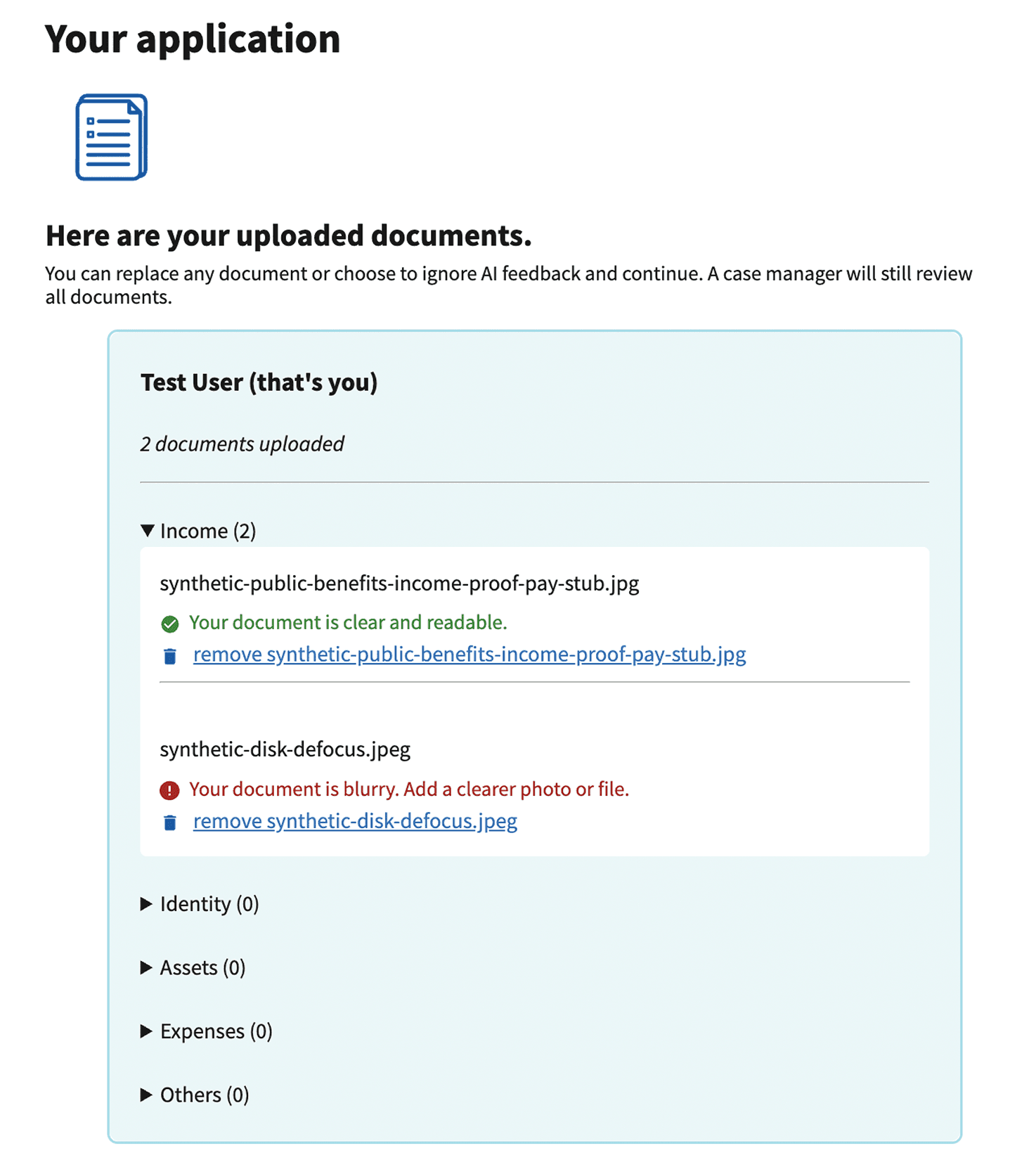
    DocumentAI reviews uploaded documents and provides feedback, flagging issues like blurriness, incorrect document type, or missing information. Applicants can choose to fix or ignore the feedback.

    In July 2025, Congress passed H.R. 1 — a sweeping bill that deeply affects how states deliver public benefits like Medicaid and the Supplemental Nutrition Assistance Program (SNAP), requiring states to reduce the payment error rates and meet expanding work requirements to retain federal funding streams. The state of Maryland brought Nava Labs on to help implement DocumentAI, an AI-powered tool that automates document verification. By automating document verification, DocumentAI gives applicants immediate feedback on their submissions. It also provides agency staff with clean, structured data to work with instead of raw scans.

    DocumentAI leverages AI-powered technology to rapidly verify income documents like pay stubs or proof of employment letters. Using optical character recognition (OCR), DocumentAI analyzes the file for accepted document type and flags issues for applicants such as blurriness or missing information. Ultimately, this helps eliminate human error, thus preventing wrongful benefit terminations for up to 80,000 affected SNAP beneficiaries and 320,000 Medicaid enrollees in Maryland.

    DocumentAI is built on Strata, Nava’s suite of open source tools that gives government agencies everything they need to run a modern service. We designed the solution as a decoupled, configurable service that can be easily integrated across agencies, in alternative policy contexts, or in other states. Instead of building a solution for one state, we’re contributing to a national model for improved document verification. 

    The most important aspect of our approach is using AI in concert with human expertise. DocumentAI never makes benefit determinations; rather, it flags potential document errors for applicants to fix in real time. Further, applicants do not have to use DocumentAI; they can decide to accept and correct their upload based on the tool’s feedback, ignore feedback, or opt out of it altogether.

    To learn more, read the full case study.

  • Reducing SNAP payment error rates with AI-powered technology

    Nava is partnering with the Commonwealth Office of Digital Experience Pennsylvania (CODE PA) and the Commonwealth’s Department of Human Services (PA DHS) to help Pennsylvania meet new federal regulations under H.R. 1. The law requires the Supplemental Nutrition Assistance Program (SNAP) to maintain low payment error rates or funding for the program will become a state responsibility. CODE PA and PA DHS implement Nava’s AI-powered document processing tool that analyzes images and documents uploaded by SNAP applicants and recipients to ensure quality and readability.

    Intelligent document processing (IDP) uses open source software and AI for quick impact and transparency. PA DHS is using Nava’s open source software solution to equip the tool with reusable and flexible software. If there are issues with a document, the user receives real-time feedback and guidance. Improving document processing helps minimize administrative burden for staff and users, and it reduces the risk of incorrect data entry due to blurry or unreadable images, ultimately helping to reduce Pennsylvania’s payment error rate.

    By supporting users' self-service document upload through AI-powered analysis and enhancement, the Commonwealth can ensure submission integrity while significantly reducing administrative burden for users and staff. The intelligent document processing tool reduces rework, mitigates risk, and accelerates benefit delivery.

    To learn more, read the full case study.