Impact statistics
10% of Maryland residents are able to use DocumentAI for new benefit applications when uploading income documents.
Over 1,800 people interacted with DocumentAI during the first month of the pilot, and 46% of those people opted to use DocumentAI
0 bugs or breaks reported so far during the pilot
Summary
In July 2025, Congress passed H.R. 1 — a sweeping bill that deeply affects how states deliver public benefits like Medicaid and the Supplemental Nutrition Assistance Program (SNAP). The legislation requires Medicaid beneficiaries to report 80 monthly hours of community engagement, which can include traditional employment or other activities like volunteering. Some beneficiaries are exempt from this rule and must submit documentation to apply for an exemption. For SNAP, state agencies must reduce their payment error rate to 6% or lower and meet expanded work requirements to retain federal funding streams. SNAP agencies had to comply with this legislation by Sep. 30, 2026, and Medicaid agencies have until Jan. 1, 2027, which gives them little time to build the necessary technological infrastructure.
The state of Maryland anticipated this challenge. With financial support from the Public Benefit Innovation Fund (PBIF), and through Center for Civic Futures, Maryland Department of Human Services, Maryland Benefits, Maryland Department of Health, and Maryland Health Benefit Exchange brought Nava Labs on to help implement DocumentAI, an AI-powered tool that automates document verification. By automating document verification, DocumentAI gives applicants immediate feedback on their submissions. It also provides agency staff with clean, structured data to work with instead of raw scans. Ultimately, this helps reduce human error, thus preventing wrongful benefit terminations for up to 80,000 affected SNAP beneficiaries and 320,000 Medicaid enrollees in Maryland.
Approach
DocumentAI leverages open source, AI-powered technology to rapidly verify income documents like pay stubs or proof of employment letters. Using optical character recognition (OCR), DocumentAI analyzes the file for accepted document type and flags issues such as blurriness or missing information. DocumentAI has additional capabilities, such as analyzing files in batches if a beneficiary uploads a zip file, that states like Maryland can use. DocumentAI is also able to analyze documents in multiple languages or ones that are handwritten.
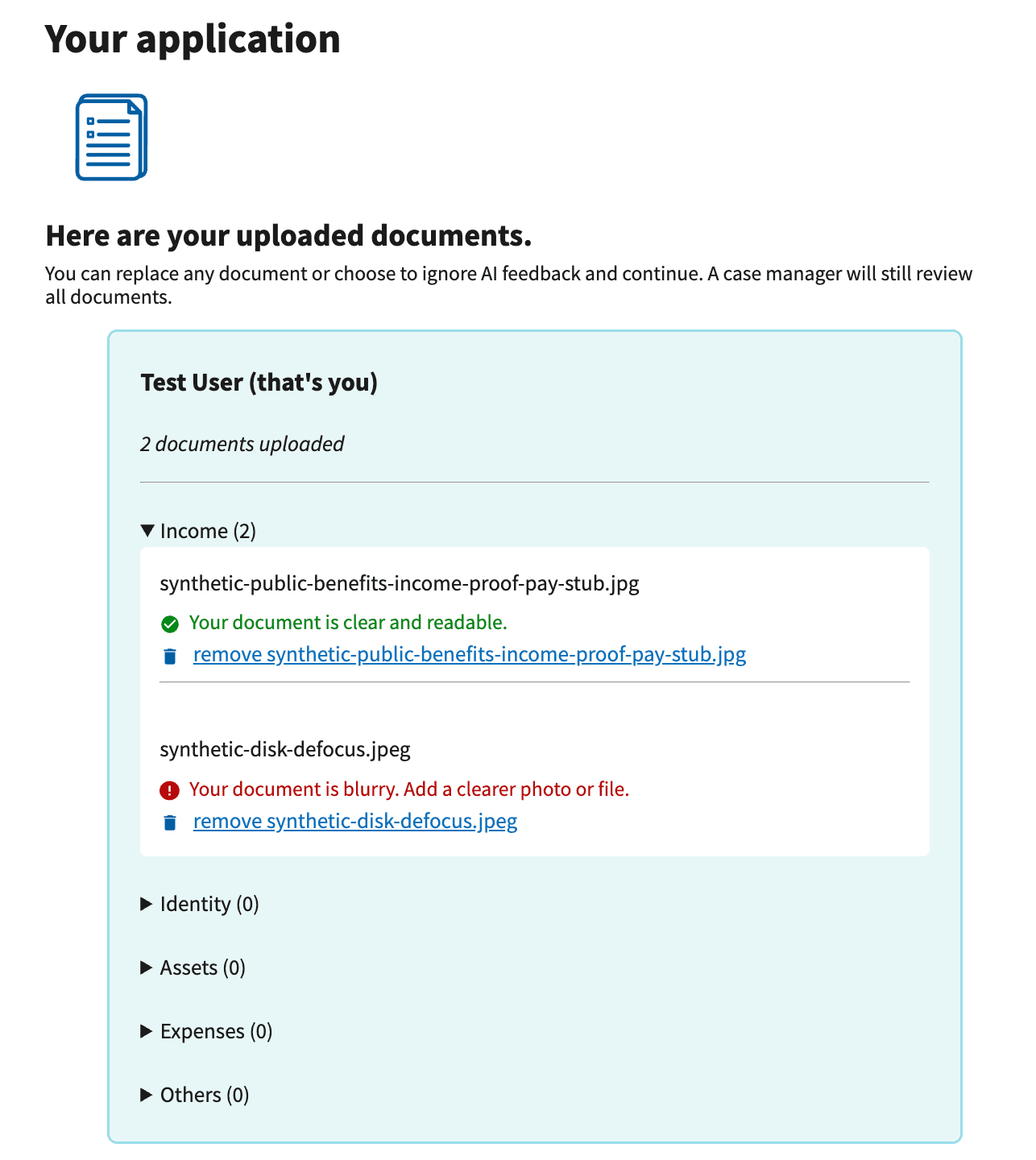
DocumentAI reviews uploaded documents and provides feedback, flagging issues like blurriness, incorrect document type, or missing information. Applicants can choose to fix or ignore the feedback.
The most important aspect of our approach is using AI in concert with human expertise. DocumentAI never makes benefit determinations; rather, it flags potential document errors for applicants to fix in real time. Further, applicants do not have to use DocumentAI; they can decide to accept and correct their upload based on the tool’s feedback, ignore feedback, or opt out of it altogether.
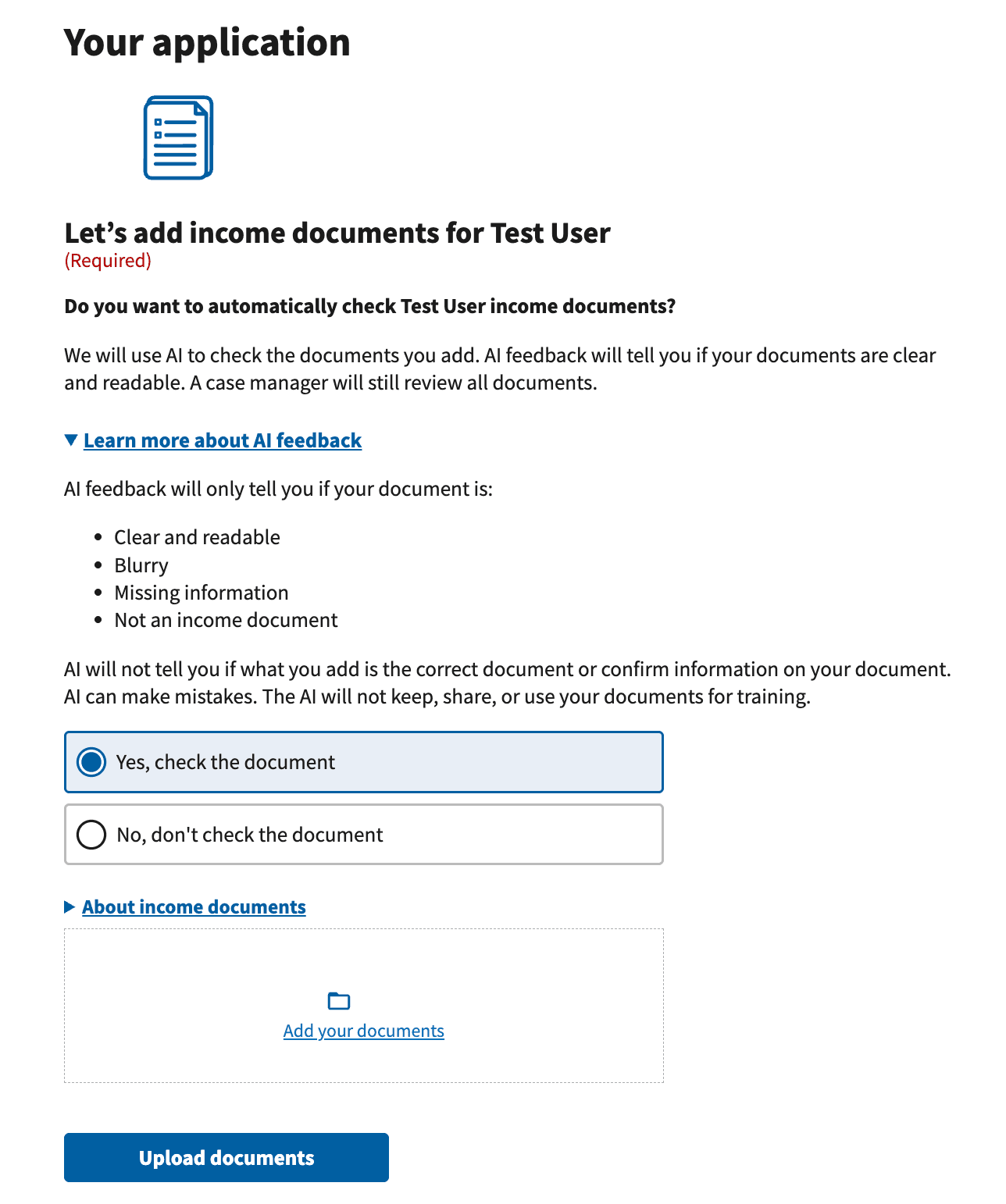
Pilot users are able to opt in to use DocumentAI to review their income documents for benefit applications.
DocumentAI is built on Strata, Nava’s suite of open source tools that gives government agencies everything they need to run a modern service. We helped Maryland implement DocumentAI in a way that prevents lock-in — the state can configure DocumentAI to best support their program needs or easily transition to another automation tool, should they choose to. The tool’s modular design and architecture also allows Maryland to scale DocumentAI so that it can be used by multiple offices or agencies, as well as enable other states or government agencies to reuse what Maryland has perfected. That means instead of building a solution for one state, we’re contributing to a national model for improved document verification.
To minimize risk and gather feedback from beneficiaries and caseworkers, we’re helping Maryland roll out DocumentAI in phases:
Phase 1: Discovery and prototype testing
Phase 2: Development, integration with Maryland’s systems, and early testing
Phase 3 (where we are now): Scaled pilot launch
Phase 4: State-wide roll out and knowledge transfer to Maryland staff
Outcomes
DocumentAI’s real-time feedback can dramatically speed up benefit determinations because it enables applicants to resolve issues immediately, rather than waiting weeks for a caseworker to manually review the application. This helps build people’s confidence in the system and frees up caseworkers’ time for work that requires human empathy. Additionally, reducing the number of overall errors can help the state save money.
For each upload, DocumentAI classifies the document type, extracts the data and generates a confidence score. This score quantifies the model’s certainty in its classification, data extraction, and document quality assessment. States can configure how DocumentAI calculates confidence scores, enabling them to set program-specific thresholds for whether a document is accepted or flagged for revision.
Finally, DocumentAI maintains a record of data to support auditing and performance measurement. This includes:
Document metadata (e.g., document type, file size, number of pages)
AI outputs (e.g., classification, extracted data fields, confidence scores, validation results)
Processing data (e.g., timestamps, response codes, processing time)
This information is sent back to the state’s system via API in a structured, auditable format to support caseworker review, reporting, and continuous improvement.
The DocumentAI pilot launched at the end of August to a selection of new applicants on OneApp, Maryland’s unified benefit application. 10% of new applicants are selected by block randomization and are able to opt into using DocumentAI for their income documents. In the first month of the pilot, over 1,800 applicants interacted with DocumentAI and 46% of those applicants opted in to use the tool. So far, none of the users requested support or reported any breaks or bugs with DocumentAI. We’ll increase availability of DocumentAI to Marylanders throughout the pilot, aiming for a statewide rollout by the end of 2026 and expanding DocumentAI to support additional document types required for SNAP H.R. 1 work reporting.
As we continue to rollout DocumentAI, we plan to track the following metrics:
Document processing and turnaround time (e.g., average document processing time and time from upload to response)
Accuracy (e.g., classification accuracy, percent of documents that meet confidence thresholds, override rates)
Cost savings and efficiency gains (e.g., reduction in caseworker review time, decrease in follow-up requests, faster time to determination)
Process
Conducting discovery research
We began this work by researching Maryland’s current processes to understand how people submit documents and how caseworkers process those documents. Our team traveled to Maryland to interview county staff about their experiences interacting with state systems, which enabled us to create a service blueprint outlining what happens to documents before, during, and after they’re submitted.
This discovery work helped us identify various points on the Maryland Benefits platform where DocumentAI could ease the document verification process. We also conducted research into other states’ systems through a multi-state cohort with the intent of contributing to a national model for improved document verification.
Building an MVP
Once we completed discovery, we embarked on an iterative process to help Maryland build a minimum viable product (MVP). Our shared goal was to start small and move quickly, so we decided to begin by focusing on income documents. We made this decision with Maryland because they receive more income documents than any other document type, so improving the income document verification process would have the biggest impact. We limited scope even further by restricting data extraction to key fields.
In building the MVP backend, we wanted to provide Maryland with flexibility to configure DocumentAI to their programmatic needs. The backend is loosely decoupled, configured to Maryland’s system, and integrated via APIs, ensuring personal identifiable information stays in Maryland’s system and follows the state’s security and compliance requirements. This means that Maryland can easily adapt DocumentAI for programs beyond SNAP and non-Modified Adjusted Gross Income (MAGI) Medicaid without “ripping and replacing.”
We were able to deliver an MVP in just a few months. The project moved quickly because we had already built DocumentAI. Maryland only needed assistance with deploying DocumentAI in their environment and configuring the tool to their policies and needs. We were also able to leverage lessons learned from Pennsylvania, where we first implemented DocumentAI to improve document verification.
As more states use DocumentAI, Nava Labs will continue to iterate on and improve the service to adapt to the evolving needs of states and their programs.
Conclusion
Nava’s Strata team built DocumentAI to reduce the burden of manual document review — a pain point across many benefit application systems. We designed the solution as a decoupled, configurable service that can be easily integrated across states, in alternative policy contexts, and for other state agencies. Following the pilot launch, we’ll design a user-friendly frontend to help Maryland to manage multi-agency use of DocumentAI. The Nava Labs effort with Maryland will also leverage a multi-state cohort to gather feedback and ensure the tool is scalable, reusable, and aligned with broader program needs and state needs.
Written by

Product manager

Editorial associate

Senior Editorial Manager