Prototyping innovative solutions

Nava Labs is partnering with local organizations, state agencies, and nonprofits to develop AI-powered solutions that help the caseworkers and staff who help people for benefits. By leveraging open source, agencies can reuse, improve, and adapt the technology to their unique needs.

This year Nava Labs worked with:

Over 200 caseworkers
Over 30 partner organizations
5 pilot programs
  • Helping Goodwill case managers connect clients with tailored resource referrals

    Goodwill’s employment support programs take a holistic approach to helping people find stable employment. Case managers don’t just match clients with job postings — they provide guidance and referrals to job training programs, financial assistance, food banks, housing programs, legal services, health services, transportation support, and more. Staying on top of this fragmented and ever-evolving landscape of publicly and privately funded resources is both cognitively and psychologically demanding.

    Nava Labs partnered with Goodwill to build a GenAI-powered Referral Generator that helps case managers quickly find and share appropriate resources and plan for each client’s situation. Nava Labs piloted the tool with 62 case managers at Goodwill Central Texas and Goodwill Keystone Area in Pennsylvania.

    The Referral Generator combines GenAI with web search and a curated knowledge base. For resources outside Goodwill, the tool combines a human-curated knowledge base with a constrained live web search to check local, fast-changing resources. Case managers review the referral results before sharing with their clients. For internal programs managed by Goodwill, the team maintains a set of structured documents like the class schedules, program descriptions, and job postings that the tool references alongside web results. This hybrid approach gives the tool context specific to Goodwill that general-purpose chatbots lack.

    Before this tool, case managers relied on a patchwork of methods to find and share these resources, each with substantial limitations. A case manager can enter their client’s needs — say, medical assistant training, interview clothes, and diapers — along with a location. The tool then searches across Goodwill’s internal programs, government resources, and community organizations to generate a list of relevant resources. Once a case manager identifies the most relevant resources, they can use the tool to generate action plans, or step-by-step guides, that provide clients with specific next steps for accessing each resource. With the Referral Generator, case managers receive two key outputs — a tailored list of resources and an action plan — to better assist clients and support their needs.

    To learn more, read the full insight.
  • Evaluating a GenAI-powered assistive chatbot for caseworkers

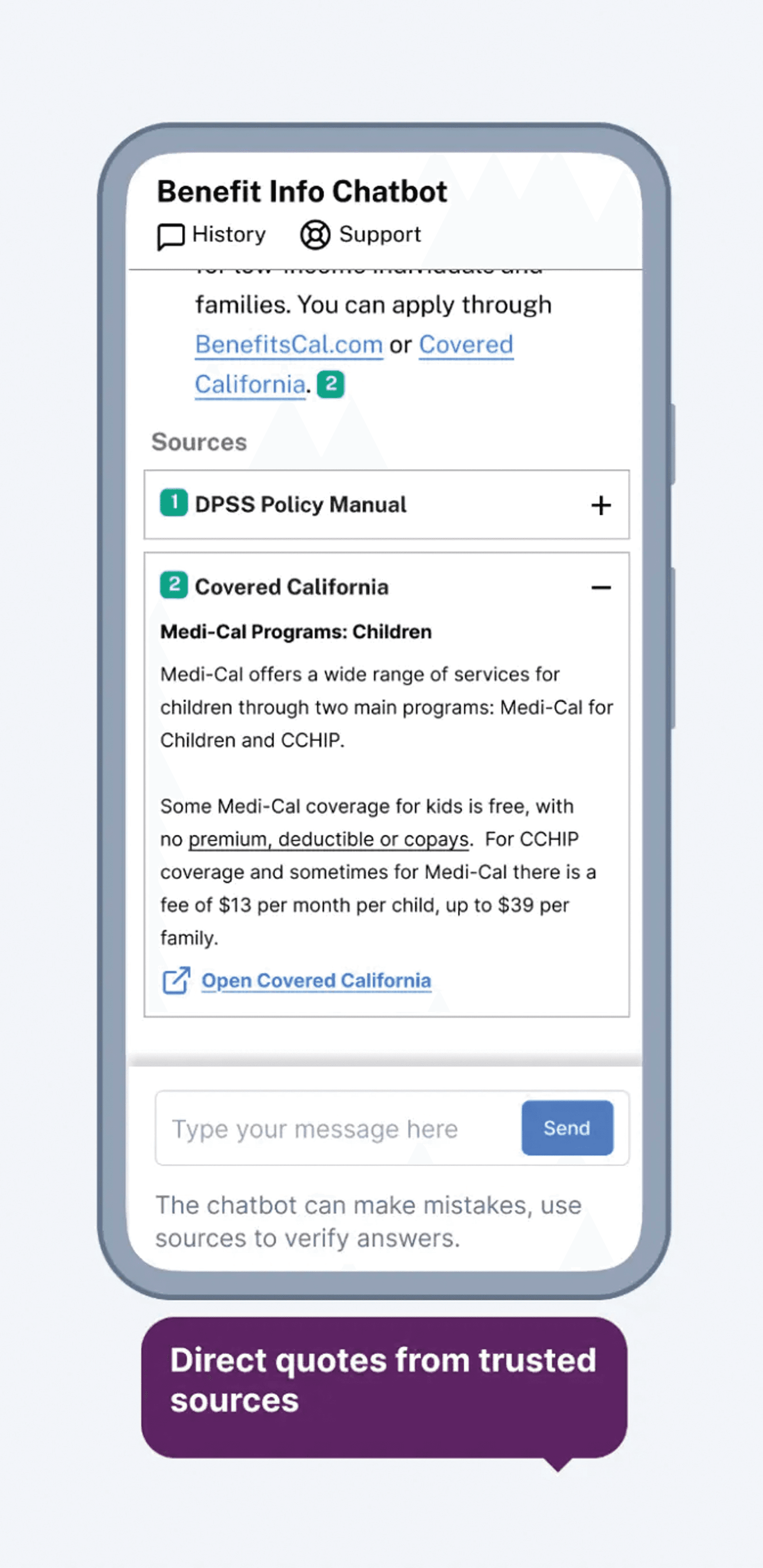
    The assistive chatbot gives direct quote citations from trusted sources.

    Nava Labs developed, piloted, and evaluated an AI-powered chatbot designed to help caseworkers more effectively support clients in finding and enrolling in public benefit programs. This first-of-its-kind study addresses how to narrow the gap of over $227 billion in annual unclaimed benefits by expanding caseworker capabilities with generative AI (GenAI) technology. Nava Labs sought to reduce administrative burden for caseworkers and enhance service delivery to clients. The chatbot was designed to make it easier for caseworkers to find accurate, timely, and citable answers to questions about health and human services program eligibility and enrollment to discuss with their clients in real time.

    The assistive chatbot explained program rules in plain language, used retrieval-augmented generation (RAG) to pull information from vetted sources, provided direct citations, supported multilingual translation, and prevented hallucinations through careful guardrails. Nava Labs built the technology to adapt to different settings and integrate with a range of different workflows through an application programming interface (API).

    The team completed several rounds of prototyping and testing with caseworker advisors in real-world scenarios to prepare the assistive chatbot for the pilot with nonprofits. Rigorous testing ensures the chatbot is ready to use in real-world settings and can collect data on caseworkers’ tool usage and impact.

    Finally, the team used a mixed-methods approach and implementation science framework to evaluate factors influencing chatbot adoption during a 14-week real-world pilot in Los Angeles County. This evaluation also included a large-scale randomized experiment with 125 caseworkers conducted in partnership with Georgetown University’s Better Government Lab and Cornell University with funding from the National Science Foundation.

    To learn more, read the full evaluation report.


    3Based on the Flesch Reading Ease score

  • Protecting personal data in AI-powered tools

    Nava Labs developed an AI-powered tool to help caseworkers fill out benefit applications on behalf of the families they serve. The Form-Filling Assistant is an open source tool and built in partnership with the Riverside County Children and Families Commission and Amplifi, with evaluation supported by Georgetown’s Better Government Lab. Because this work involves sensitive and personal information security and privacy protections are paramount. When developing the tool, Nava Labs built security into every layer of the system from the model that processes the data to the interface caseworkers use to review the form before submitting.

    While developing the tool, Nava Labs heard from caseworkers that clients would trust the tool with their personal data because they trust their caseworker’s recommendations. That trust is why families agree to try the tool at all, underscoring the importance of protecting their data.

    Some of the security came from the providers used to build the tool: Claude processes client data without storing it or training on it, Google Cloud Gemini Enterprise hosts the tool without routing data to outside servers, Kernel runs each session in its own isolated browser environment, and Google Cloud’s FedRAMP High infrastructure holds the application to the federal government’s standard for sensitive data. Each provider also has its own certifications and audits.

    Nava Labs also added their own layers of security like system prompt instructions that prevent the tool from submitting an application, an interface design that lets the caseworker take control, and a review card that traces every field back to its source. This combination of both external certifications and internal guardrails provide caseworkers with the assurance that their clients’ data is protected.

    To learn more, read the full case study.

  • Strengthening AI adoption and governance with evaluation

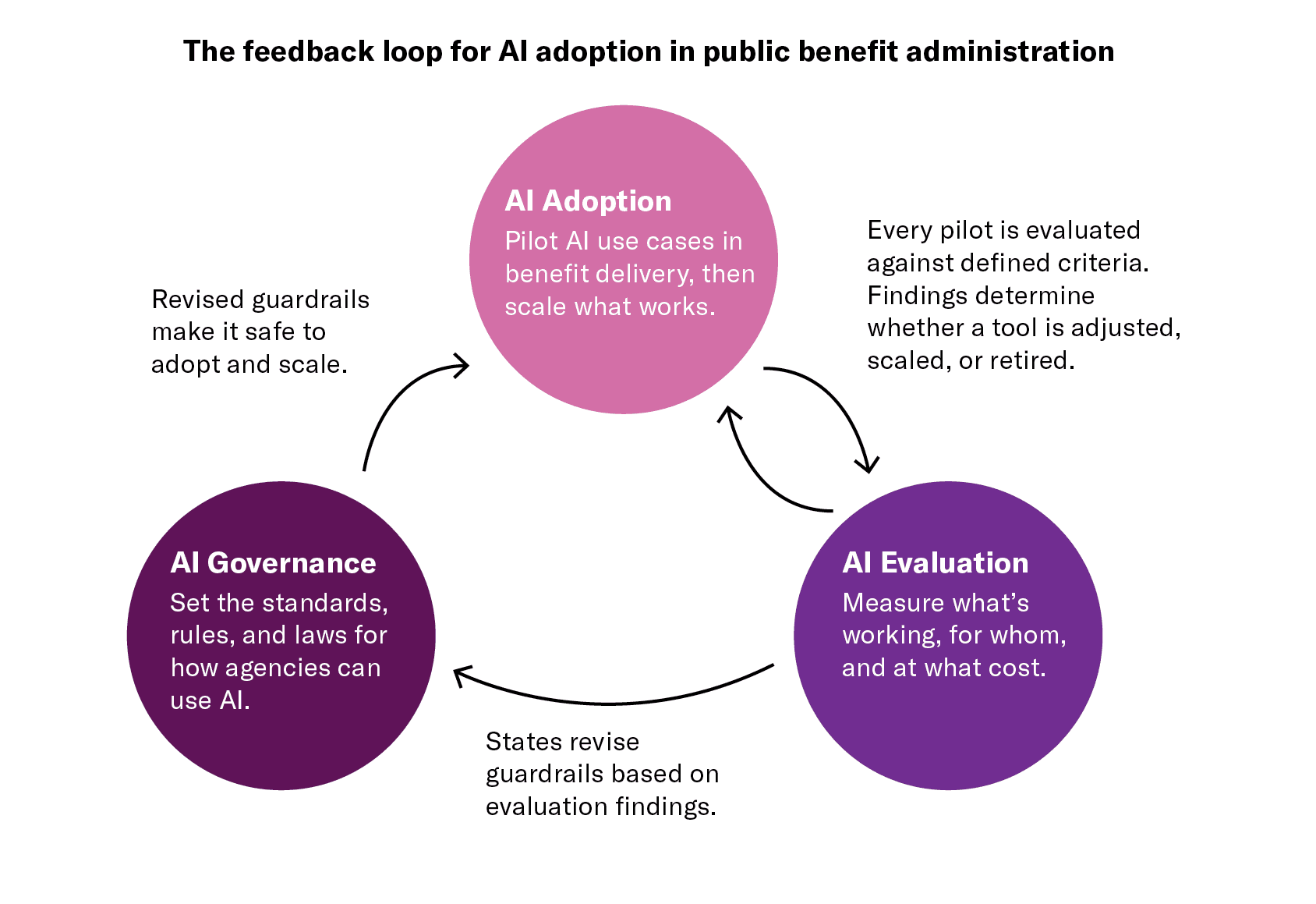
    Nava Labs researches and tracks AI adoption and policy in the public benefit space, including where state governments stand today and what “good” adoption might look like. We’re seeing a pattern where AI adoption is outpacing the two things that should be keeping it accountable: evaluation and governance. We think good practice looks like a feedback loop, where governance feeds adoption, which feeds evaluation, which feeds back to governance and adoption.

    As we’ve tested this hypothesis, we’ve identified three major gaps in states’ current practices and crafted recommendations for how to address them.

    First, states evaluate AI-powered tools for technical performance, not program outcomes: Did it reduce the SNAP payment error rate? Did it decrease churn among participants subject to work requirements? Did it reduce denials for failure to return verifications? These are the kinds of questions state agency leaders need to answer, but can have a hard time getting data for. At minimum, all AI-powered tools deployed in public assistance programs should be able to answer the following: Does it reduce caseworker burden? Does it improve client access? Does it cause unintended harm?

    Second, what one agency learns rarely reaches the next. User research and evaluation findings often stay with the implementing vendor or agency, so agencies duplicate work and deployments don’t build on each other. Around 14 states publish, or are required to publish, inventories for either high-risk or all AI use cases within government agencies. That’s a good start, but the approval process should also be clear, simple, and time-bound in a way that encourages agencies to disclose their use cases. Additionally, agencies’ inventories should capture evaluation results and lessons learned.

    Third, almost no state with a written AI policy has a process for revising it. AI technology is changing rapidly and what once made sense when it was published may not hold up against the capabilities of newer models or agentic AI. States should revisit their AI governance regularly, especially early in a state’s experimentation with AI.

    Read more about our research findings and ideas on Nava Labs Field Notes, Nava Labs’ dedicated Substack.