2026 is in full swing at Nava Labs and the landscape has shifted.
2025 was a year of emergent tools and breakthroughs in artificial intelligence. We spent it alongside partners like Goodwill, Amplifi, and Riverside County, piloting and testing responsible applications of AI to ease longstanding burdens in navigating public benefit programs. Through these partnerships, we gained a deeper understanding of what actually works for people seeking help and for those on the frontlines of government programs. We learned that:
An assistive chatbot can support caseworkers as they answer questions from people applying for benefit programs, enabling an estimated 42% relative increase in response accuracy.
A chatbot that cites its sources can earn the trust of caseworkers. Our chatbot received an 8 out of 10 rating in how likely caseworkers are to recommend the tool to colleagues.
Families often face an information overload when looking at social programs they might apply for.
Agentic AI tools improve service delivery, but only when teams center human expertise and relationships during development.
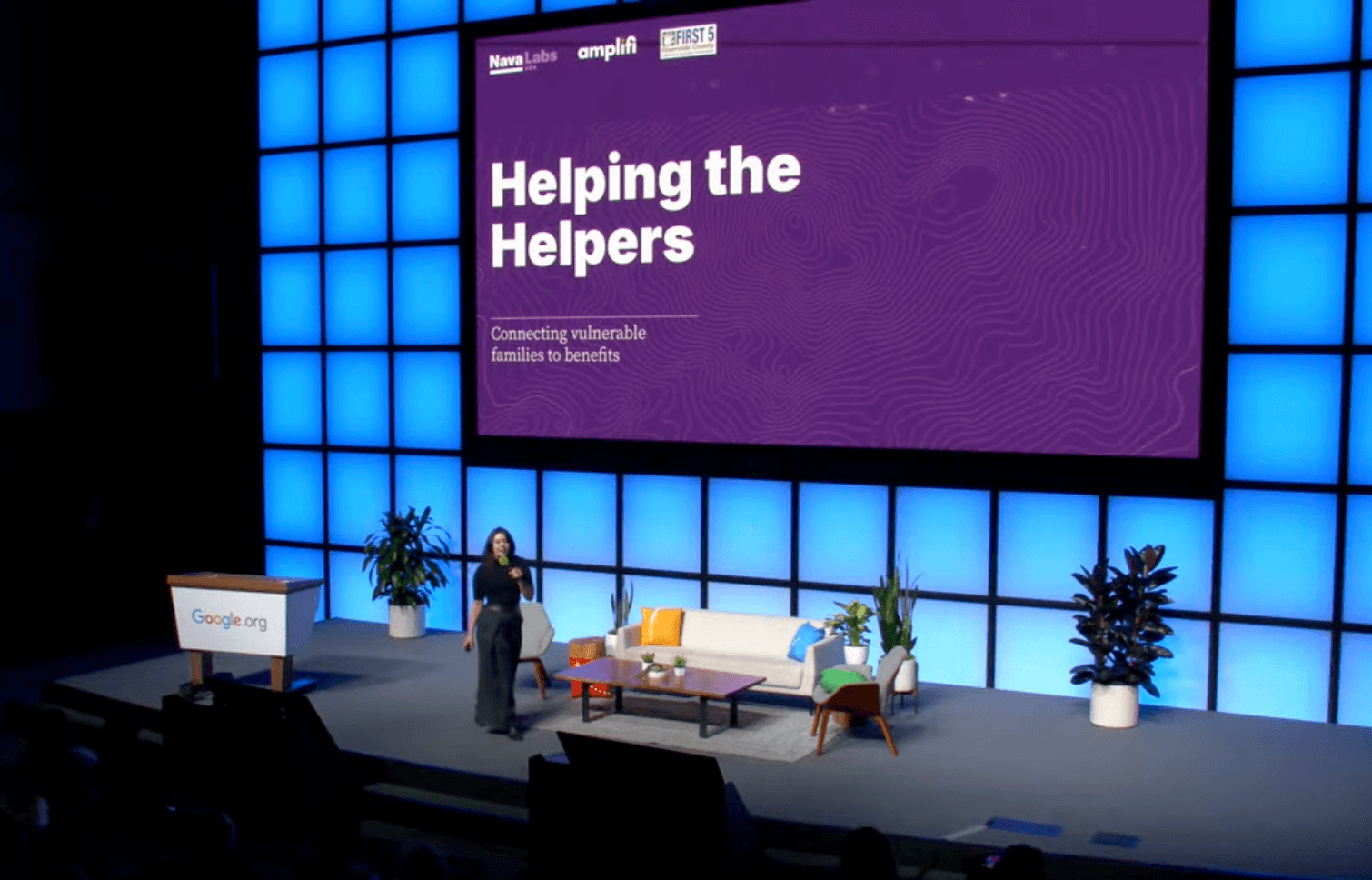
We ended 2025 with a big moment: demo day at the Google.org Accelerator, where we announced our caseworker empowerment toolkit. You can watch the recording here.
Looking at last year as a whole, we learned that AI-powered tools have a lot of potential to support caseworkers as they help families, which we validated through our work on the Assistive Chatbot and Form-Filling Assistant. We also learned about specific ways caseworkers use these tools and what they find most helpful.
Everything we learned and accomplished in 2025 prepared us for the challenges of 2026 — a year that brings urgency. Policies are changing fast, agencies are under pressure with constrained budgets, and the question of whether generative AI can deliver in production is no longer theoretical. This year will be a proving ground for AI in government and for the long-term sustainability of public services.
As government invests in AI, it’s crucial for agencies to adopt processes that promote transparency and combat vendor lock-in. For too long, government has relied on traditional procurement processes that leave agencies dependent on individual providers and drive up costs over time. Government cannot rely on these broken processes, given the high stakes that come with AI-enabled technology.
We believe that open source offers a fundamentally different path, where we can share proven tools across jurisdictions, adapt them to local needs, and improve tools collectively. As we evaluate how AI tools should show up in the public sector, it’s undeniable that these tools should be trustworthy, sustainable, and transparent.
For example, we’re leveraging what we learned from working on the Assistive Chatbot and Form-Filling Assistant to develop a comprehensive Caseworker Empowerment Toolkit. The toolkit marshals together a suite of tools to support caseworkers across a range of avenues in their work while incorporating findings from our usability testing. It aims to reduce burden on caseworkers by providing them with actionable advice, and to ensure that caseworkers can offer human-centered services to their clients.
Below are other examples of how we’re leading the charge on responsible AI implementation this year.
Making open source tangible through H.R. 1 and PBIF
H.R. 1 is sweeping federal legislation that established work reporting requirements for certain benefit programs. After the bill’s passage, Nava responded to the moment by announcing a toolbox to help states implement the legislation without affecting benefit delivery in Medicaid and the Supplemental Nutrition Assistance Program (SNAP). Nava Labs is taking part in Nava’s H.R. 1 response with the State of Maryland and the American Public Human Services Association (APHSA), through the Public Benefit Innovation Fund (PBIF).
With the PBIF grant, we’re building open source, AI-enabled modules with Maryland. We’re working with APHSA to make those modules scalable and available to other states facing constraints like tight budgets, rapidly changing policy, and hard deadlines for H.R. 1 compliance.
Shaping California’s approach to AI in government
Nava Labs recently joined the Emerging Technology Accelerator within Governor Newsom’s Innovation Council. Through the accelerator, we’re supporting the State of California as it explores ways to improve critical service delivery and incorporate new technologies, including AI, to better serve Californians. This work builds directly on a perspective we’ve maintained over the last decade as a public benefit corporation: that responsible implementation requires deep understanding of both the technology and the people it serves, and that state governments need trusted partners who are focused on public outcomes, not product sales.
Building together
Nava’s mission as a public benefit corporation is to build simple and effective government services. Nava Labs has always doubled down on that mission while maintaining a commitment to the public good. We see open-sourcing all of Nava Labs’ AI efforts as central to that goal. Transparent, open tools are how we break the cycle of costly, proprietary systems, giving agencies real ownership over mission critical technology.
We’re enthusiastically seeking partners from all sectors who are ready to create transformative tools, technology, and processes that promote safe, healthy communities and enable trust in public institutions. If that sounds like your organization, get in touch.
The work ahead is urgent and we’re ready. Let’s build together.
Written by

Director of Nava Labs